What a factory game is
You place machines, link them with belts or pipes, and watch what comes out. All the fun is in the tuning: finding the link that is too slow, seeing a chain finally run without a hiccup, doubling your output in one evening. People call them factory games, automation games or, in the community, "factory builders".
The genre has two big names. Factorio is played in 2D, from above. Satisfactory is played in 3D, in first person. Both can be played with friends. They brought in players who like blueprints, numbers and factories that never stop.
What co-op changes
Alone, you decide everything and tune everything. With friends, the factory becomes a shared building site, and three things show up.
- Roles. Someone looks after power, someone else transport, a third person production. It works very well as long as everyone knows where their zone ends.
- Collisions. Two players lay belts in the same spot, a third cuts the power by moving a machine. You have to talk.
- The host's machine. In most games, the session runs on one player's computer. If that computer is slow, everyone slows down with it. See CPU or graphics card.
What to look at when you choose
- The view. From above, you see the whole factory at once. In first person, you walk through it and see the machines at your size, but you lose the overview.
- The goal. Some games have no end: you expand for the sake of expanding. Others give you a target to reach, which makes a session easier to finish with friends.
- Player count and connection. How many slots? A server to rent, or one player hosting? A code to share, or an address to open on your router?
- Length. A ten-hour game can be finished with friends. A fifty-hour game takes planning over several weeks.
- Load on your computer. A factory of several hundred machines needs a good processor. Check the stated system requirements before you invite everyone.
- Price, and the save. Who keeps the game? What happens to it if the host leaves?
Where Lost Wallet fits
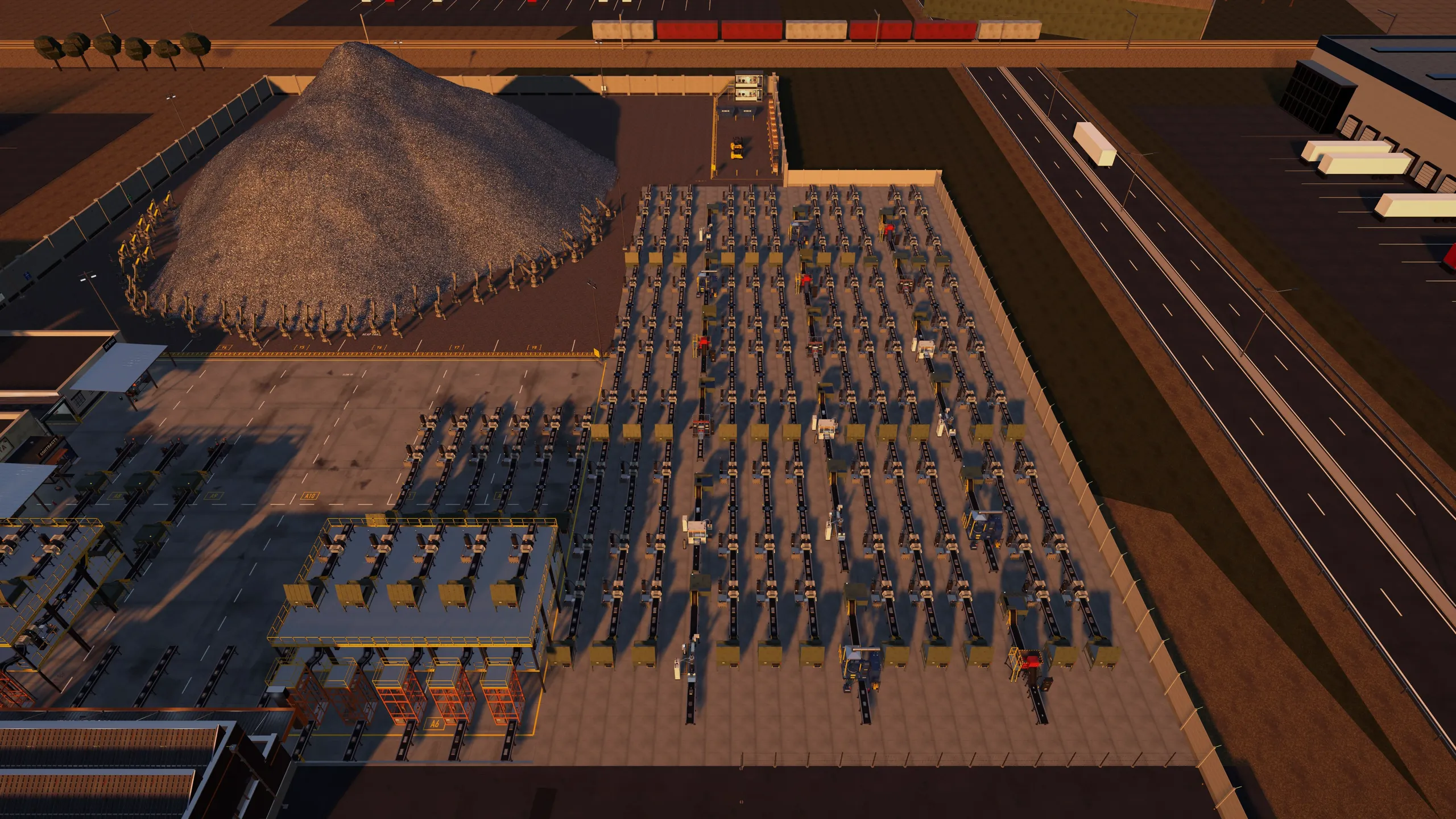
Lost Wallet is a 3D factory game in first person, for 1 to 4 players. It has one particularity: a single raw material. Everything starts from the same object, a hard drive.
- The setting. A pile of millions of hard drives, from 1 million to 300 million depending on the game. One drive holds 8,000 bitcoins. The other wallets are smaller.
- The goal. Empty the pile fast enough to find that drive. Everything the factory produces, the recycling, the sales, the power, goes into digging faster.
- The chain. Extractor arms pull the drives out, scanners read them, sorters split them up. Empty drives are taken apart, melted down, sold. In the end the factory makes brand new SSDs and USB keys.
- The co-op. One player hosts, with no server to rent. The others join with a six-character code. The cash is shared by the whole team.
The game is not out yet: it is coming to Steam, and you can add it to your wishlist. Two limits to know about: there is no voice chat (the easiest fix is to talk on Discord), and play between a Mac and a PC has not been checked yet.
For a first co-op game
- Read the co-op guide together: hosting, joining, inviting through Discord.
- Pick a small pile for a first evening: an Express game is announced at about two hours solo.
- Split up the zones before you place the first machine. A four-player split is suggested in this series.
- Keep the factory numbers handy: one scanner for three extractors, and one diesel generator is enough for a line.